They Only Sound Like Bumbling Goofs

It never pays to be cranky and sarcastic on social media (unless you’re writing about Chad Kroeger or Justin Bieber; then, all bets are off), which is why I enjoyed reading in the Democrat and Chronicle about what Vidler’s 5 & 10 in East Aurora, NY is doing with its YouTube channel. Here’s a seasonal sampling:
Given the lack of blog activity, it looks as if the store is using its channel as its primary content marketing tool, blasting out awareness through Facebook and good ol’ fashioned PR. This makes perfectly good sense: with limited resources, it pays to focus on one social media outlet, commit to it with regular updates, and make the content distinctive enough so that it is of real value and interest to people.

These videos are wildly entertaining, but even if you find them hokey, you’ll at least get some good product ideas.

Vidler’s are stone-cold social-media ninjas.
Responses to NPR’s Dropping World of Opera, Lisa Simeone Firing

A few responses to NPR dropping Lisa Simeone’s World of Opera because of her involvement in organizing protests in DC, and her firing as host of Soundprint for the same reason:

  • On his Baltimore Sun blog, David Zurawick says that NPR has a code of ethics and needs to enforce it.
  • Libertarian website Reason thinks that the lengths NPR goes through to prove its objectivity only emphasizes its editorial bias; better just to acknowledge it and let its employees be Prius-driving, yoga-loving, liberal lunatics. 

On a related note, Michelle Norris, whose husband is now an Obama 2012 advisor, recently quit her job as All Things Considered host to avoid the appearance of conflict of interest.

Second Thoughts on Using Amazon’s Cloud Drive

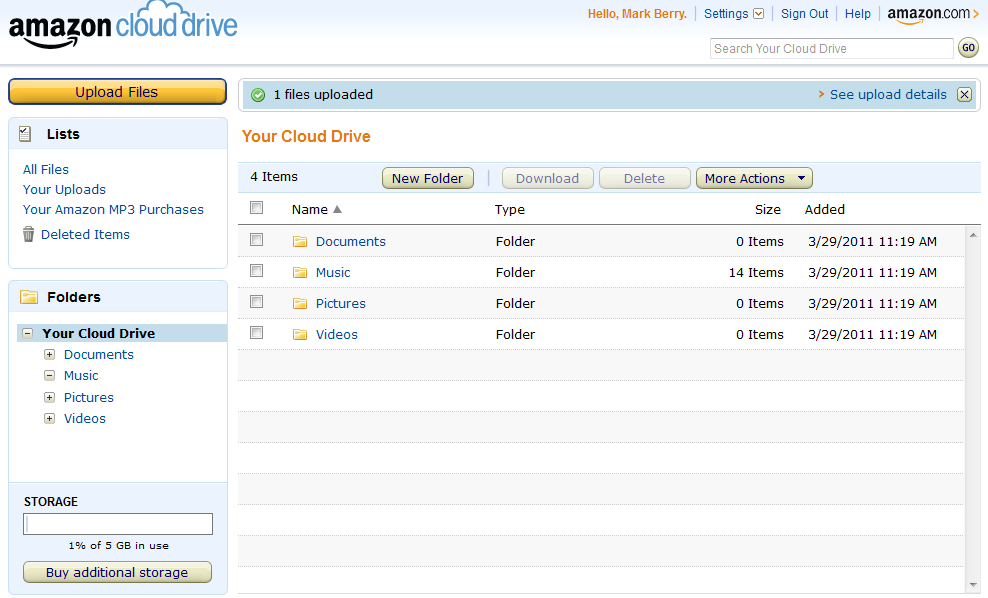
Because it uses Flash, there’s only an Android app for Amazon’s new Cloud Player–nothing for iPhone. But I’m having no problem installing the MP3 Uploader on my MacBook and can upload and play tracks through Chrome and Safari. At least I can listen through my computer at work (a PC) and through portable speakers at home (the Mac).

Here’s the thing: to upload all of my music from iTunes to the Cloud Drive, I need 20 GB of storage and they only give me 5 GB for free. If I buy an MP3 album from Amazon, I get that additional 15 GB without cost for a year. But what do I do after a year? Then I pay $20 annually to keep my music in the locker. That’s pretty cheap, but I’m not going to go for it before I see what Google’s got to offer. 
For now, I’ll live with my free 5 GBs, and because they’ll let me store anything I buy from them for free,  I’ll use Amazon’s MP3 store. (See: they got me!)
Want more? 
Matt Brian speculates that all of this is a prelude to Amazon releasing their own Android tablet. Glenn Peoples of Billboard has weighed in on his blog, and Ben Parr of Mashable has some first impressions

First Thoughts On Using Amazon’s Cloud Drive

The new Amazon.com “storage locker” for music (and other stuff) is nothing fancy; it’s even more boring to look at than iTunes.

I put up Fully Completely and am listening to it now. Loading the album was a drag: I had to upload track by track. You can download an app that helps with uploading, but I’m at work and the firewall’s blocking this. I’ll have to try it out at home.

I couldn’t use Chrome to upload and had to shift to Firefox–not a big deal, but I use Chrome as my default.

I went home and tried playing around on my Mac.

Picking on the Carcass of the Music Industry Can Be Fun and Rewarding

Through the Daily Dish, I found this Pop Matters article on the music you can find in CD bins at 99 cent stores.

Thanks to the complete devaluing of the CD and the ruination of the recorded music industry, you can find better than ever stuff at places that used to only stock not-played-by-the-original-artists ’70s hits packages. I found Boston’s second album at the drug store last week for well under $10. Thanks to Pathmark, I got to know the artistry of Waylon Jennings just a little bit better.

Now’s the time to get out there and make your finds. While we still have the chance.

It’s All About the Ask

Executive Director Lynne Meloccaro on why the American Symphony Orchestra offered its players salaries instead of maintaining the pay-for-service model it’s been operating under for years:

We didn’t want to do that because the perception people had that orchestras were collapsing all over the place was affecting philanthropy.

The primary reason that Ms. Meloccaro gave wasn’t artistic (although music director Leon Botstein said that it was “a way of stabilizing a very fine orchestra”) or at all related to ticket sales (that an ever-shifting roster would result in inconsistent performances and a lack of personal identity that could repel audiences).

This move had everything to do with the ask. No one will donate to a non-profit that is crumbling. The new ASO contract, so Ms. Meloccaro hopes, sends a signal to large donors that the orchestra is on sound financial footing.

You might want to keep ASO’s reasoning in mind the next time you see a non-profit arts organization put on a program that seems to have little reason for being, that couldn’t possibly pull in a crowd large enough to justify its existence.

The Detroit Symphony management might want to keep Ms. Meloccaro’s words in mind as they try to resolve the strike with musicians. I know things look bleak in Motor City, but GM did post a third-quarter profit.

NEA Arts Journalism in Classical Music in Opera

Sophia Ahmad posted her wrap-up on the NEA’s Arts Journalism in Classical Music and Opera on the Des Moines Register website yesterday, a ten-day workshop with a couple of buddies of mine: Joe Horowitz and my colleague at Carnegie, Gino Francesconi.

If the takeaway was “Speak your mind, support it well,” I suggest that Ahmad–and all journalists–amend the mantra to include another line: “Expand your mind, and don’t stop learning.”

Live Music and the Union

I was thinking of going to Matthew Bourne’s Swan Lake’ at City Center, but then I read on NYTimes.com that the production was using recorded music. I can’t go for that. I really miss having a live band with dance.

Of course, the local American Federation of Musicians agrees. They demonstrated against City Center, handing out leaflets: “There is no music tonight” and “This is going to be a fake performance,” they said.
Is this really the best the union can do? In a sensible, oganized, adult way, AF of M needs to start making the case for music. This doesn’t cut it.

Fort Worth Symphony Musicians Protest Contract Offer

As reported on dfw.com today, the Fort Worth Symphony contract negotiations are growing contentious. The musicians, who have been without a contract since August 1, silently protested management’s proposed cuts on stage last weekend, although most audience members probably missed its significance.

Which is part of the point: it sounds as if the Fort Worth community just doesn’t care very much. Concert sales are down $120,000, and the orchestra had to cancel a number of concerts this year. The municipal arts council sharply cut its funding as well.
The musicians are probably, as orchestra president Andrea Koonsman notes, out of touch with financial realities (including the lack of community support), but it’s also worth looking at the way she and her team has overseen things. Last year, the orchestra lost $242,000 on a $11.9 million budget, according to the article. And they’re paying their music director over $300,000.

Naxos Will Distribute Warner Classics CDs in US

Naxos will start distributing Warner Classics CDs here in the US, starting September 1. There is no digital component to this deal, and it looks as if Warner’s plan is to offload this expensive, shrinking revenue stream to the independent company so that it can focus on other things. As John Kelleher, head of Warner Classics and Jazz puts it: “(this deal) enables Warner Classics to re-focus our efforts on growing our digital business in the region, as well as bolstering our A&R activities.”

To anyone paying close attention, this isn’t a surprise. In a conversation with Tim Smith of the Baltimore Sun, Naxos founder Klaus Heymann let it slip that this deal was done. Naxos has been growing stronger as a distributor over the last five years or so, particularly here in the US. And classical divisions have been the ugly stepsisters in major label families for a couple of decades.

Major labels have always looked down on the upstart Naxos, and it’s hard to say whether this is indicative of how far the latter has come, or how far Warner has fallen. 

Want Money? Build Trust

In his article on the Philadelphia Orchestra’s plans to re-invent itself in the face of a “structural deficit,” Peter Dobrin quotes Executive Director Allison Vulgamore: “We’re going to have to earn more money, going to need to attract donors back … who have been waiting and wondering, and, frankly, we’re going to have to measure the cost structure a little bit.”

So, I’m not quite sure what a “cost structure” is, but I do know that if the Philadelphia Orchestra is going to want people to give money, they’ll need to be honest about not just how much they’re spending, but what they’re spending it on.

That’s what’s so galling–and counterproductive–about the orchestra’s unwillingness to discuss the value of Yannick Nezet-Seguin’s contract. It could have been a great opportunity to educate the public on the value of a music directors to the overall quality of the institution that donors are giving money to. Instead, they politely “decline” to discuss it, even as their board chair mentions bankruptcy.

If you want people to give you money–more importantly, if you want them to really believe in you–you’ve got to be straight with them.