Today, the New York Times classical-music critics each picked two contemporary operas of note, one of which was to have found a “niche” in the repertoire. Here’s what Steve Smith picked:
Robert Ashley’s Perfect Lives is available on DVD, if you’re interested, or you can watch it on YouTube. Someone on YouTube commented that they remembered this airing on the USA Network in the early ’80s.
Tag: American Music
Better Know a Composer: Ernst Toch
If you know Ernst Toch for anything, it’s probably this:
“Geographical Fugue”is a perfect tongue twister of a showpiece for high-school and university choirs, the kind of rhythmic, referential, kind-of-humorous diversion that moms and younger brothers love (“Hey ma, it’s just a bunch of names of places! Lake Titicaca! Get it: titty-kaka? Ha!”).
It certainly didn’t start out that way.
The “Geographical Fugue” was the third movement of Gesprochene Musik (Spoken Music), which Toch premiered at the Berlin Festival of Contemporary Music in 1930. Toch had not written the piece to be performed live, but rather had it pre-recorded and played back at 45 rpm on a gramophone:
Gesprochene Musik was a wry bit of musical experimentation, an early example of electronic experimentation shot through with Weimar-era modernist wit.
Three years later, as the Nazis came to power, Toch’s burgeoning career in Germany ended when he fled continental Europe. After two years in London–productive ones, he scored three films–Toch made his way to the United States, first settling in New York, and then moving to Los Angeles. There, he earned a living writing film soundtracks, ultimately writing 16 and earning three Academy Award nominations.
It was also in Los Angeles, during a 14-year period from 1950 until his death in 1964, that Toch wrote all seven of his symphonies. Although the New Grove Dictionary of Music and Musicians dismissively describes them as “late Romantic,” Toch’s symphonies are skillful, entertaining, and moving, combining the best of Wagner, Strauss, and Schoenberg with sharp modernist shocks that provide moments of genuine drama:
Symphony No. 3, premiered by the Pittsburgh Symphony on December 2, 1955, won the Pulitzer Prize the following year, but the fifth is also highly recommended.
Lou Reed Helped Me Make It Through High School
I don’t think there was one person in my high school–metal and musicals ruled there–who had even heard of Lou Reed’s New York, but I couldn’t get enough of all that righteous, liberal sarcasm; loosey-goosey rockabilly; and monotonous sprechstimme. The album was all mine, and when you’re 16 going on 17, you want something that’s yours and yours alone. Plus, it’s one of the few albums not country that sounds great through a pickup truck’s speakers.
Van Cliburn Died Today
It’s hard to get just how famous Van Cliburn was back in the years after he won the first Tchaikovsky Competition in Moscow (he got a ticker-tape parade in Manhattan, and his first album went platinum)–and what it meant to go into the heart of Soviet territory and show them how to play a signature work by their own legendary composer. His win was Paul Henderson’s goal in the 1972 Summit Series, Rocky’s pounding of Drago, Reagan’s “tear down this wall.”
I wrote about his performance of Tchaikovsky’s first concerto a few years back, and the best obituary I’ve seen today has been NPR’s. Take some time and listen.
Cheesy Classical Music You Should Know: Fanfare for the Common Man
In 1977, Emerson, Lake, and Palmer recorded their own, nine-minute blues-jam version of what is probably Aaron Copland’s single most famous piece. The cover was a big hit–perhaps also the nadir of art rock–and CBS used it as the opening theme for its Saturday-afternoon sports show, CBS Sports Spectacular, a low-rent version of Wide World of Sports:
Outside of the concert hall, this is how most people (at least those of a certain baby-boomer age) have come to know Fanfare for the Common Man; that’s a shame, because inside of the concert hall, its distinctive, sweeping opening always exhorts goosebumps.
Copland wrote the piece on commission in 1942 from Eugene Goosens, who at the time was the music director of the Cincinnati Symphony Orchestra. Goosens contacted 18 composers to write fanfares that would be “stirring and significant contributions to the war effort” (this was only shortly after Pearl Harbor). He ended up using nine of them for Cincinnati’s 1942-43 season, including Copland’s, which is pretty well the only one still heard today.
A few years later, Copland used Fanfare for the Common Man in the finale of his Third Symphony, which you can hear here.
The Problem with Glorifying Rural Life
According to an article on the Poverty Reference Bureau website based on the work of William O’Hare, rural poverty is more prevalent than urban poverty; just under 24% of children in rural areas live in poverty (as of 2007), compared with around 18% in urban areas. Rural poverty is also tenacious:
… while many people move in and out of poverty as their circumstances change, spells of poverty last longer for rural children. They are the “forgotten fifth” of poor children because most programs and policies to help the poor are focused on urban areas.
Appalachian Spring, listening to “Flyover State,” that farmer ad on the Super Bowl: all help us feel a little bit better about the reality of this situation. They tell us that it’s OK, that the grit and ingenuity of these (white, they mostly are white) people will carry the day, that they’ll lift themselves out of the rut, carry themselves through hard times.
Out on the Farm, in the Middle of Nowhere
I started watching Martha Graham’s Appalachian Spring tonight:
It’s every bit a stylized, essentialized view of rural life as this:
Or this:
Watch Philip Glass’s Walt Disney Opera Online
Right now, Medici.tv is streaming Philip Glass‘s brand new The Perfect American live from Teatro Real in Madrid:
Medici.tv keeps the recording up for a while, so if you don’t see it tonight, you can come back to it later.
Koyaanisqatsi and the "Crying Indian"
The so-called “crying Indian” ad is the most famous (or infamous) example of a patronizingly essentialist view of American Indians as environmental augurs:
I think Koyaanisqatsi is another. The only words you hear in the film are Hopi. Koyaanisqatsi means “life out of balance,” and the chorus that is part of Philip Glass‘s score intones three tribal sayings that can be interpreted as being warnings about the impact of human actions on the world.
It’s certainly not mean-spirited but can nonetheless be as limiting and de-humanizing as any cowboy-movie stereotype.
It’s as if They Read My Mind
Look what was in my mail today:
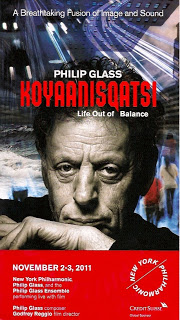
I’ll probably just stay home; I can watch the movie for free on YouTube. By the way, Philip Glass’s 75th birthday is coming up on January 31, in case you’re wondering why you’re seeing so much of his music programmed this season.
Watch Koyaanisqatsi with Music by Philip Glass for Free
Love it or hate it, Koyaanisqatsi is now available to stream for free on YouTube. The commercial breaks are jarring, but it’s a great, free way to get your Philip Glass fix at work (or at home).
It’s also on Hulu.
Philip Glass: "My Frontiers Are Behind Me"
In this short promotional video for the Brooklyn Academy of Music, Philip Glass talks a little bit about his increasing interest in the classical-music tradition as a source of inspiration:
This has been going on for a while. Some people love his symphonies, string quartets, and the like; others don’t. Back in the fall of 2010, Robert McDuffie toured the country with Glass’s nod to Vivadli, American Four Seasons. In the Chicago Tribune, John von Rhein called it, “a Glass half empty.” Mike Paarlberg loved the piece, mostly for not sounding like Koyaanisqatsi.
Across the pond, two different reviewers for the same paper had very different opinions, as Richard Guerin points out. In the London Telegraph, Ivan Hewett hailed American Four Seasons as “classic art”; Michael White called it “unmitigated trash.”
Here’s the last movement. Decide for yourself:
 Mark Likes Music
You must be logged in to post a comment.