Since just after Christmas, the Syracuse Symphony Orchestra had been trying to raise money to save its season. They didn’t quite get there: today, its board of trustees announced that it is cancelling the rest of the season, citing, in part, its inability to reach its March fundraising goal.
Second Thoughts on Using Amazon’s Cloud Drive
Because it uses Flash, there’s only an Android app for Amazon’s new Cloud Player–nothing for iPhone. But I’m having no problem installing the MP3 Uploader on my MacBook and can upload and play tracks through Chrome and Safari. At least I can listen through my computer at work (a PC) and through portable speakers at home (the Mac).
Here’s the thing: to upload all of my music from iTunes to the Cloud Drive, I need 20 GB of storage and they only give me 5 GB for free. If I buy an MP3 album from Amazon, I get that additional 15 GB without cost for a year. But what do I do after a year? Then I pay $20 annually to keep my music in the locker. That’s pretty cheap, but I’m not going to go for it before I see what Google’s got to offer.
For now, I’ll live with my free 5 GBs, and because they’ll let me store anything I buy from them for free, I’ll use Amazon’s MP3 store. (See: they got me!)
Want more?
Matt Brian speculates that all of this is a prelude to Amazon releasing their own Android tablet. Glenn Peoples of Billboard has weighed in on his blog, and Ben Parr of Mashable has some first impressions.
First Thoughts On Using Amazon’s Cloud Drive
The new Amazon.com “storage locker” for music (and other stuff) is nothing fancy; it’s even more boring to look at than iTunes.
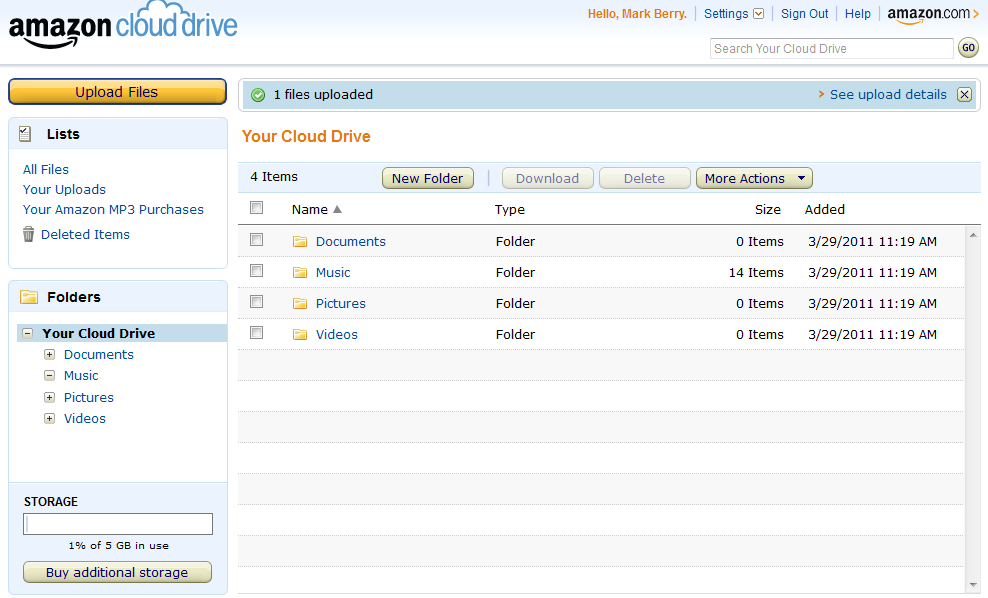
I put up Fully Completely and am listening to it now. Loading the album was a drag: I had to upload track by track. You can download an app that helps with uploading, but I’m at work and the firewall’s blocking this. I’ll have to try it out at home.
I couldn’t use Chrome to upload and had to shift to Firefox–not a big deal, but I use Chrome as my default.
Better Know a Composer: Luciano Berio (Part II)
Berio’s Italian, but he has some strong connections to the US and New York City in particular. He wrote Sinfonia for the 125th anniversary of the New York Philharmonic in 1968. This was no commission to an out-of-towner: Berio had been teaching at Juilliard since 1964, and before taking the Juilliard job he had taught at Mills College in Oakland for two full school years. He studied at Tanglewood in 1952 with Luigi Dallapiccola and then returned as an instructor in 1960.
As the second movement of Sinfonia, Berio included a version of his 1967 piece O King, an elegiac tribute Martin Luther King, Jr.
Originally scored for a small ensemble and one singer, O King (here in its symphonic arrangement) projects the individual syllables of the phrase “O Martin Luther King” into the surrounding musical landscape; gradually they coalesce to sound out the slain civil-rights leader’s name at the end of the piece.
Even if you can’t hear this, it’s a beautiful, powerful piece. And for all its avant-garde pretensions, it’s general form–slow and steady progress toward a definite endpoint–is pretty conventional.
Better Know a Composer: Luciano Berio
I recently posted a note on the Carnegie Hall blog about Mozart’s Zaide, which in the version that Ensemble ACJW is performing on Thursday really isn’t Mozart’s at all. Throughout the unfinished singpspiel is music that Luciano Berio (1925-2003) wrote back in 1995: the show starts and ends with it; it interrupts the action at two points during of the opera. Whether you like it or not, Berio’s music asserts itself and–as a recurring comment on the action–hijacks the event.
Berio showed a penchant throughout his career for this kind of appropriation, and people who know his music will compare the Zaide music to the third movement of Sinfonia (1968).
Spoken texts from Beckett’s The Unnamable–and Berio’s own writings–uncomfortably intermingle with Mahler’s scherzo movement from the Second Symphony, and quotations of Schoenberg and Debussy (for example). Here, things are not cut and dry: although Mahler is the clear focus, all the borrowed material works together–and gets worked upon. Nothing appears whole and unmolested, as it does in the Zaide commentary.
Although Berio was Italian, he had strong connections to New York and the US (click here for more).
Happy Birthday Bach
Your time at the top was short, cut down by those flannel-wearing, shoe gazing, heroin addicts.
Apparently, Bach is Canadian. You know who’s not Canadian? The Irish Rovers.
Hey, They’re Irish: The Muppets
Speaks for itself, really:
Thanks to Liz.
Speaking of Liz, Thin Lizzy is Irish. So are the Irish Rovers (although I thought they were Canadian).
Hey, They’re Irish: The Irish Rovers
Because they started out in Toronto, I always assumed The Irish Rovers were Canadian. I guess I was wrong, but they were all over the CBC in the 1970s.
I had no idea “The Unicorn” was a song by Shel Silverstein. Clearly I don’t know much about the Irish Rovers. If you can stand it, here’s a video.
Or you can listen to Thin Lizzy, who are also Irish.
Hey, They’re Irish: Thin Lizzy
Hard rockin’ and totally ignorant of terms related to American football, Thin Lizzy recorded “Whiskey in the Jar” in 1972. It was their first hit.
Finally, I Can Walk from My Apartment to a Concert
My wife and I play “Riverdale Would Be Better If” a lot. Thanks to Mark Mandarano, the game just got a little easier (or harder; we have one less answer, at any rate).
This past Sunday, I went to hear his Sinfonietta of Riverdale. They played some typically facile French music–and Varese, sticking out like the most beautiful sore thumb I’ve ever seen. Although I have my suspicions that Mandarano was trying to hide Octandre from ticket buyers (the piece was conspicuously absent from the website), he doesn’t typically shy away from programming interesting, challenging music.
Up next for the group: Wagner and Schoenberg on May 15 at the Riverdale Temple. If you’re interested, check out their website or follow them on Facebook.
Everyone Likes Pi: It Sounds Delicious
Michael John Blake’s “What Pi Sounds Like” has become quite the YouTube sensation–and the go-to story subject for Pi Day today. NPR.org ran a piece on Morning Edition and it’s up on Time‘s website. Gizmodo, Salon.com, The Stir, and Wired‘s “Geek Dad” blog: all mention the clip.
Then there’s my friend Peter MacDonald, who clearly takes Pi Day very seriously.
Pi Day’s Coming Up: Here’s Something to Help You Celebrate
I was going to wait, but just couldn’t contain myself (and neither could Peter MacDonald, who mentioned this on Facebook.)
Pi Day is coming up, and Michael John Blake is paying tribute to everyone’s favorite mathematical symbol through music. He explains:
I can’t wait to hear what he comes up with for Pie Day.


You must be logged in to post a comment.