First Thoughts On Using Amazon’s Cloud Drive

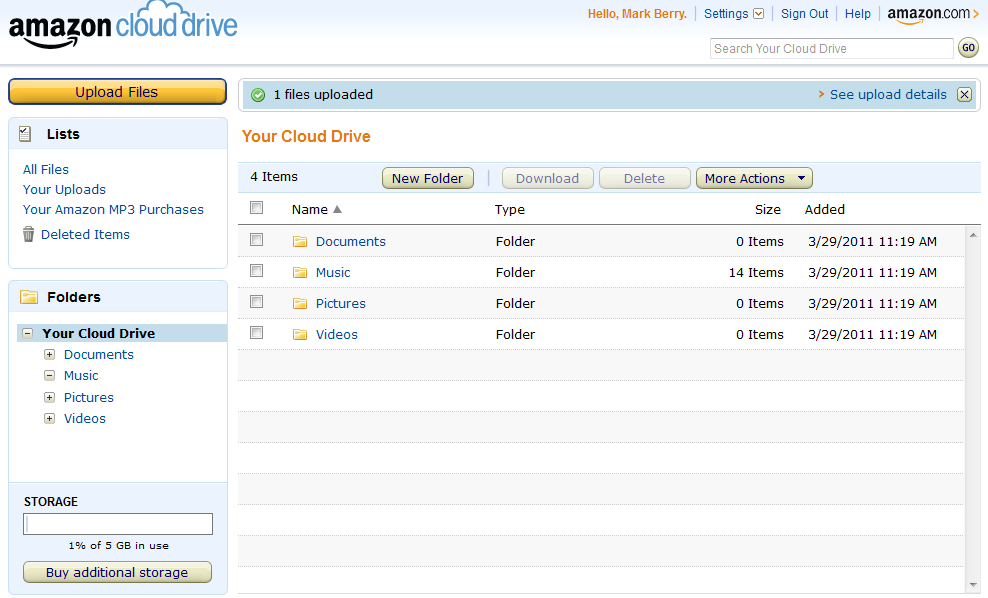
The new Amazon.com “storage locker” for music (and other stuff) is nothing fancy; it’s even more boring to look at than iTunes.

I put up Fully Completely and am listening to it now. Loading the album was a drag: I had to upload track by track. You can download an app that helps with uploading, but I’m at work and the firewall’s blocking this. I’ll have to try it out at home.

I couldn’t use Chrome to upload and had to shift to Firefox–not a big deal, but I use Chrome as my default.

I went home and tried playing around on my Mac.

Better Know a Composer: Luciano Berio (Part II)

Berio’s Italian, but he has some strong connections to the US and New York City in particular. He wrote Sinfonia for the 125th anniversary of the New York Philharmonic in 1968. This was no commission to an out-of-towner: Berio had been teaching at Juilliard since 1964, and before taking the Juilliard job he had taught at Mills College in Oakland for two full school years. He studied at Tanglewood in 1952 with Luigi Dallapiccola and then returned as an instructor in 1960.

As the second movement of Sinfonia, Berio included a version of his 1967 piece O King, an elegiac tribute Martin Luther King, Jr.

Originally scored for a small ensemble and one singer, O King (here in its symphonic arrangement) projects the individual syllables of the phrase “O Martin Luther King” into the surrounding musical landscape; gradually they coalesce to sound out the slain civil-rights leader’s name at the end of the piece.

Even if you can’t hear this, it’s a beautiful, powerful piece. And for all its avant-garde pretensions, it’s general form–slow and steady progress toward a definite endpoint–is pretty conventional.
Better Know a Composer: Luciano Berio

I recently posted a note on the Carnegie Hall blog about Mozart’s Zaide, which in the version that Ensemble ACJW is performing on Thursday really isn’t Mozart’s at all. Throughout the unfinished singpspiel is music that Luciano Berio (1925-2003) wrote back in 1995: the show starts and ends with it; it interrupts the action at two points during of the opera. Whether you like it or not, Berio’s music asserts itself and–as a recurring comment on the action–hijacks the event.

Berio showed a penchant throughout his career for this kind of appropriation, and people who know his music will compare the Zaide music to the third movement of Sinfonia (1968).

Spoken texts from Beckett’s The Unnamable–and Berio’s own writings–uncomfortably intermingle with Mahler’s scherzo movement from the Second Symphony, and quotations of Schoenberg and Debussy (for example). Here, things are not cut and dry: although Mahler is the clear focus, all the borrowed material works together–and gets worked upon. Nothing appears whole and unmolested, as it does in the Zaide commentary.

Although Berio was Italian, he had strong connections to New York and the US (click here for more). 

Finally, I Can Walk from My Apartment to a Concert

My wife and I play “Riverdale Would Be Better If” a lot. Thanks to Mark Mandarano, the game just got a little easier (or harder; we have one less answer, at any rate). 
This past Sunday, I went to hear his Sinfonietta of Riverdale. They played some typically facile French music–and Varese, sticking out like the most beautiful sore thumb I’ve ever seen. Although I have my suspicions that Mandarano was trying to hide Octandre from ticket buyers (the piece was conspicuously absent from the website), he doesn’t typically shy away from programming interesting, challenging music. 
Up next for the group: Wagner and Schoenberg on May 15 at the Riverdale Temple. If you’re interested, check out their website or follow them on Facebook. 

I’ve Kind of Been Wondering the Same Thing

If you want to know how rock died, go to Steven Hyden’s 10-part series Whatever Happened to Alternative Nation?. It takes forever–I’m only halfway through–but it’s worth it.  

I particularly appreciated his evenhanded assessment of Guns N’ Roses: in revealing how fraudulent metal bands had become, they were a psychotic precursor to Nirvana.

Yes, it helped that I was only 10 at the time, but GNR was unnerving in a way that even the scariest of metal bands couldn’t touch … Nirvana is credited with making ’80s hair-metal bands look silly with Nevermind, but GNR had already done that with the “Welcome To The Jungle” video several years earlier.


It’s this GNR that I remember–not those purveyors of cheese that brought us Use Your Illusion. Only a couple of weeks after the band filmed that “Jungle” video, I saw them open for The Cult in Halifax. They were loud, crude, clearly drunk. Best of all, they weren’t Poison.

Better Know a Composer: Wallingford Riegger (Part II)

In addition to Dichotomy, it’s important to mention the piece that made Riegger’s name, Study in Sonority. He wrote it in 1927 for his Ithaca Conservatory summer-term orchestra; the group had mostly violins, so he wrote for 10 violinists. At Eastman, Howard Hanson programmed the work before Stokowski got a hold of it and performed it with the Philadelphia Orchestra strings in 1929 at Carnegie Hall and in their home city.
The New York Philharmonic played the piece a couple of times in the 1960s, and in 1994 at the American Eccentrics festival. There’s nary a commercial recording to be had, but you can view the score on the New York Philharmonic’s digital archives.