Cheesy Classical Music You Should Know: The Hallelujah Chorus

Pretty well everyone has heard the Hallelujah Chorus:

It’s a Christmas staple, on its own or as part of Handel’s Messiah; it’s also become one of those pieces that people love to make their own.

Since 1993, Marin Alsop has been performing a gospel version of Messiah, conceived with Bob Christianson and Gary Anderson, called Too Hot to Handel, with a particularly swinging Hallelujah Chorus:

Here’s a “mildly cynical update” by Edward Current and Steven Clark from the UK (only Brits would find this “mildly cynical”):

And only Canadians would find a Hallelujah Chorus flash mob cool:

This Week in National Anthem Disasters

Anthem fails: they’re not just for Americans anymore.

Deadspin gives an account of this very, very unfortunate version by Measha Brueggergosman of my country’s big song:

While the average length of “O Canada” as sung before an athletic contest is a bit shy of 50 seconds, Brueggergosman stretched it to almost two minutes and drew titters from players on both benches as she warbled her way through a nearly unrecognizable rendition. 

The most cringe-worthy moment comes when, clearly dying out there, the Canada’s Got Talent judge enthusiastically calls for the crowd to sing along. Polite Canadians, they do.

I wonder how the Kazakhs would handle a butchering of their national anthem? Maybe we’ll find out:

It was pretty classy of the medalist, Maria Dmitrienko, to keep her composure in what could only have been a humiliating and confusing situation.

Beer Music

Signature Brew of London has released Craig Finn’s Clear Heart, a nod to the Hold Steady singer’s new solo album.

Pairing up with musicians to co-brand lines of beer is Signature Brew’s marketing hook, but so far it has only one other act on its roster, a band called the Rifles.

And how do you drink this beer? In a red solo cup, of course:

I Went to a Concert, and a Hockey Game Broke Out

Last Thursday, someone punched a 67-year-old man in the face while listening to the Chicago Symphony Orchestra play Brahms.

It didn’t really rise to the level of a riot, but a lot of concerts have. Josh Kurp picked his top five music riots on Encore Magazine’s website. So did Laura Mann of the Dallas Observer.

Both mention Altamont and the Who’s 1979 concert in Cincinnati, as well as the 1913 Rite of Spring premiere. But Mann picks as her top choice something we don’t hear much about: a 1949 concert by Paul Robeson show in Peekskill, NY that was undermined by the KKK.

Zooey Deschanel’s National Anthem, Or How (Not) to Talk About a Performance

Two responses to Grantland‘s broadside against Zooey Deschanel’s national anthem bring up a problem that confounds everyone concerned with analyzing music: the difference between a transitory live performance, where an audience measures success in that moment, using a set of expectations conditioned by context; and t a recording of the same event, a mediated experience that listeners experience individually, over and over again.

Jason Heid, on Dallas’s D Magazine tells us what it was like to experience Deschanel’s rendition at the game:

I was at Rangers Ballpark for Game 4 last night, and loved the sense of melancholy with which Deschanel infused the familiar song. It felt almost like a funeral dirge, and I mean that as a high compliment. It was quite different from what we normally get at these games: when some mid-level country music or top 40 star is trotted out for a serviceable, but instantly forgettable, performance. 

A reader of Andrew Sullivan’s The Dish makes the point that the Deschanel version, as opposed to the much praised Whitney Houston’s at the 1991 Super Bowl, was perfect to sing along with:

Zooey sang it like she meant it. Even the way she softened the ends of most of the lines gave the audience room to hear themselves singing along, and isn’t that supposed to be the point?
Her job was not to deliver an aria to a silent hall; it was to lead the crowd in singing the song. 

However dramatic or pleasing Whitney Houston’s rendition might have been, you can’t sing along to it. you can only listen … Singing the national anthem is supposed to be a participatory ritual, not a spectator sport. 

Is it fair, as Grantland did, to evaluate a live performance based on a video recording of it? Are Caspian-Kang and Vargas-Cooper (these are their names, really), and Jason Heid responding to the same thing at all? And do we really want to sing along?

It Wasn’t as Bad as All That, Was It? Zooey Deschanel’s National Anthem

Relax, guys. On Grantland, Jay Caspian-Kang and Natasha Vargas-Cooper rant over this:

Here’s a sample:

Where have our divas gone? There is no strife in ZoZo’s lily-white aesthetic. No sex, no violence, just tweeting. What a tepid and sniveling symbol she is. She has nothing to draw on, nothing to find resonance in. She’s not even fit for our time. Give us a beleaguered icon. Someone trying to maintain their imperial draw even though they’ve grown bloated and waterlogged with age. I want to hear the sounds of a woman who has known loss and triumph, not the pubescent squeaks of a flinching sitcom star with cute bangs and a stupid blog. 

Very classy.

There have been far worse renditions of our national anthem, and many better. If you can stand reading their childish drivel, Caspian-Kang and Vargas-Cooper have their own best-of list.

Responses to NPR’s Dropping World of Opera, Lisa Simeone Firing

A few responses to NPR dropping Lisa Simeone’s World of Opera because of her involvement in organizing protests in DC, and her firing as host of Soundprint for the same reason:

  • On his Baltimore Sun blog, David Zurawick says that NPR has a code of ethics and needs to enforce it.
  • Libertarian website Reason thinks that the lengths NPR goes through to prove its objectivity only emphasizes its editorial bias; better just to acknowledge it and let its employees be Prius-driving, yoga-loving, liberal lunatics. 

On a related note, Michelle Norris, whose husband is now an Obama 2012 advisor, recently quit her job as All Things Considered host to avoid the appearance of conflict of interest.

Koyaanisqatsi and the "Crying Indian"

The so-called “crying Indian” ad is the most famous (or infamous) example of a patronizingly essentialist view of American Indians as environmental augurs:

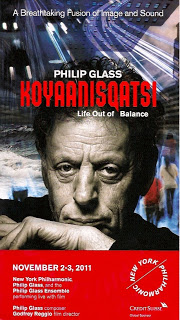
I think Koyaanisqatsi is another. The only words you hear in the film are Hopi. Koyaanisqatsi means “life out of balance,” and the chorus that is part of Philip Glass‘s score intones three tribal sayings that can be interpreted as being warnings about the impact of human actions on the world.

It’s certainly not mean-spirited but can nonetheless be as limiting and de-humanizing as any cowboy-movie stereotype.