Education and Money Keep People Away from Cultural Institutions

It seems to me that if we really want to diversify cultural audiences, we should get more people of color into college and more money in their pockets.

I say this after reading a recent study on cultural attractions put out by Morey Consulting last month through LinkedIn noting that, relative to the census, Blacks are underrepresented as attendees by 50%, Hispanics by 250%. One of the major barriers to entry for all racial groups was price: 17.4% of Black respondents worried about cost, as did 20.4% of Whites, and 30% of Hispanic respondents. The median income for Blacks, as Morey Consulting points out using 2018 US Census data, is 41% lower than that for Whites, and 52% lower than the median income for Asians. Hispanic median income is 27% and 40% lower than White and Asian incomes, respectively. Those involved in the study who attended cultural attractions made more across the board, but there were still striking disparities between races: Black visitors made 24% less than Whites and 32% than Asians, and Hispanic visitors made 17% and 25% less.

Education is a huge predictor of whether people will attend a cultural attraction. While only 24% of Blacks and 17% of Hispanics in the US have a college degree, 68% of Black and Hispanic cultural attendees completed an undergraduate program. (By comparison, 38% of Whites and 55% of Asians in the US hold degrees, and 76% and 88% of attendees from those groups hold degrees, respectively.) The good news is that Blacks and Hispanics with degrees come out and take part in cultural activities; the bad news is there are just too few within those groups who have gone to college to move the needle.

By pointing out that money and education are important impediments to cultural attendance for Black and Hispanic populations, I don’t mean to imply that they aren’t for other racial groups. White participants in the Morey study were 3% more concerned about price than Black participants, and Asian concern was at 29.2%, practically on par with Hispanics at 29.6%. And there are a lot of Whites with only a high-school diploma out there who aren’t going to cultural attractions.

What I am saying is that the economic and education barriers are most pronounced among those who identify as Black or Hispanic, two racial-ethnic groups that cultural attractions and arts organizations particularly aspire to attract. And although I’ve seen other studies and surveys identify both level of education and price as primary barriers for cultural participation, I have yet to see anyone in the arts-and-culture field pose any solutions as to how we can remove them.

Leaders who really want to ensure that our cultural institutions will be enjoyed and supported today and for generations to come will recognize that higher education is the key, and that economic stability provides people with the security they need to explore their intellectual curiosity. It’s tough for non-profit cultural groups to talk about political issues–they can lose the support of major donors or even their 501(c)(3) status–but doing so now might help set the foundation for a renewed interest in culture that can help everyone.

Concerts Are Back!(?)

The Vienna Philharmonic gave its first concert since March 10 earlier this week, and it looked like a real blast:

Thanks to COVID-19, only 100 people were allowed into the almost-3,000-seat Musikverein. Concertgoers needed to enter with a mask on, but they were allowed to take it off once they were seated (which makes me wonder if Viennese officials know what hole the virus comes out of when we breathe). Concertgoers sat alone–families and households weren’t allowed to clump together–and there was no intermission. Get it, sit down, get out, hope you don’t die.

On the German side of the border, the State Theater of Hesse in Wiesbaden (it’s by Frankfurt, I guess) hosted baritone Guenther Groissboeck, who performed for 200 people in the 1,000-seat hall on May 18. People had to wear face masks and provide their contact information beforehand, but they could sit together in groups.

Here in the United States, on the same night as Groissboeck’s recital, Travis McCready gave a socially distanced concert to around the same number of people in Fort Smith, Arkansas. The US has almost 30% of the world’s confirmed COVID-19 cases, the most of any country.

To prepare for the McCready concert, according to Digital Music News, staff at Temple Live sprayed the venue with “sanitizing mist.” People had to wear masks and drink out of closed containers. How they drank with their masks on, DMN did not say.

A Canadian survey showed that 21% of live-music fans would “probably never” feel comfortable in a traditional concert environment, and the vast majority of people have said they’ll wait until a vaccine arrives before returning. As a COVID-19-safe alternative, presenters and promoters are turning to so-called drive-in concerts. Keith Urban and Alan Jackson performed shows at drive-in theaters in Tennessee and Alabama, respectively, and Garth Brooks’s upcoming concert will be re-broadcast to 300 drive-in theaters around the country. Mark Rebillet is in the middle of an eight-city drive-in tour.

The idea behind drive-in concerts is that your car could provide an almost impervious layer of protection between you and the outside, germ-spreading world. But what would you do if you wanted to get out, spread your legs, enjoy the night air? You could walk around wearing this:

This is the Micrashell protective suit, “specifically designed to satisfy the needs of nightlife, live events and entertainment industries,” according to its makers. It’s got an N 95 filtration system in its helmet and a special system that allows you to drink and vape (I’m not sure if you can do them at the same time; that’d be cool, though). Because the suit is “top only,” users can wear their normal street clothes–because you don’t want to look conspicuous in the club–and easily “engage in intercourse without being exposed to respiratory risks.”

We all know we’re living a nightmare, right?

Music Responds to George Floyd

Musical responses to the May 25 death of George Floyd at the hands of Minneapolis police have been many and varied. I’ve tried to keep a log of all of the expressions of anger, confusion, and sadness that I’ve seen, but they’ve come so fast that it’s nearly impossible to keep up. Below are a few highlights from the past couple of weeks, things that have either generated their own media coverage, have trended on social media, or have simply caught my eye.

Last Friday, Anthony McGill posted a video on Facebook of himself performing a mournful rendition of “America the Beautiful” before kneeling as if in prayer; he then issued a #taketwoknees challenge to other musicians to post their own videos and join the “struggle for justice and decency.” Scores of people have responded from all over the country.

In the days immediately after Floyd’s murder, gospel star Kirk Franklin posted a piano improvisation as tribute, and 12-year-old Keedron Bryant posted “I just wanna live,” an anthem his mother wrote for him. Absent any context, this is the one that got to me the most: hearing the voice, seeing the young man drove home that the protests and the outrage are first and foremost about wanting to stay alive, to simply live.

On June 2, the music industry participated in Blackout Tuesday, a movement that gained steam after an article in Variety. Jamila Thomas of Atlantic Records and Brianna Agyemang of the talent-development company Platoon came up with the idea of taking a day of silence to contemplate the industry’s role in perpetuating racism and how it can help end it. Most companies treated Blackout Tuesday as a social-media challenge, posting black squares on their feed, and the subsequent copycat posts from individuals led to a certain amount of confusion on the web. The idea of the music business taking a step back to examine itself is a good one though, given its history.

Carnegie Hall participated in Blackout Tuesday, and the following day they used their Carnegie Hall Live digital platform, started in response to the COVID-19 shutdown, to stream a 2017 recording of Joel Thompson’s Seven Last Words of the Unarmed, conducted by Eugene Rogers and performed by the Sphinx Symphony Orchestra and the University of Michigan Men’s Glee Club.

Inspired by Shirin Barghi’s #LastWords art project, Thompson sets the last words of seven Black men murdered by police: Kenneth Chamberlain, Trayvon Martin, Amadou Diallo, Michael Brown, Oscar Grant, John Crawford, and Eric Garner. In his raw and moving essay for WQXR, James Bennett, II writes:

Like the religious musical settings from which Seven Last Words takes its name, Joel Thompson’s piece forces the listener to sit in anguish, meditating on death and all the events leading up to it. It forces us to consider that a White Plains review of Chamberlain’s killing found the shooting “justifiable.” That the man who killed Trayvon was rewarded with acquittal, and later built a personal brand out of his violent antagonism. It reminds me that one of the officers who shot Diallou went on to shoot and kill a 22-year-old several months later, and have his “valour” rewarded with a promotion to the rank of sergeant in 2015. I’m reminded of a grand jury’s decision to not bring charges against the murderer of Michael Brown. Thompson’s music makes me think about the paltry two-year sentence given to Grant’s killer, and the decision to not bring charges against the officers responsible for Crawford’s death or the man who placed the fallacious 911 call that prompted the incident. It makes me think of the man who choked Eric Garner, specifically his transference to a desk job and the reported pay raise he received in 2016.

Listen to the piece; read the essay.

To the degree that there is a lighter side to things, this video, shared on Twitter by Zoe Madonna (@knitandlisten) earlier this weekend, is as close as we’ll get:

This musical lesson on the faulty assumptions about crime in Black neighborhoods began as a video on Tik Tok–where a mash-up of “This is America” has become the go-to musical expression of protest–by @rynnstar. Alex Engelberg then added the backing vocals. I haven’t been able to get it out of my head all day.

Want to help out? Donate to one of the following:

Black Lives Matter

NAACP Legal Defense Fund

National Bail Fund Network

Sacred Music Sunday: William Byrd

A desire, borne of guilt, to get back to church-going arises in me around Easter, and this year I decided to do something about it and start watching the services posted online by the local Episcopal Church. I figured that I really had no excuse, as video had taken away all the typical impediments that had kept me from attending in person: the need to shower, get dressed, get in a good enough mood to be around others. And because the services have been recorded and left on YouTube, I haven’t even had to get up for a 10 o’clock service. All I’ve needed to do every Sunday is pick an hour when I can sit by myself with a set of ear buds and my phone. As a lazy, slightly skeptical, churchgoer, it’s been heaven.

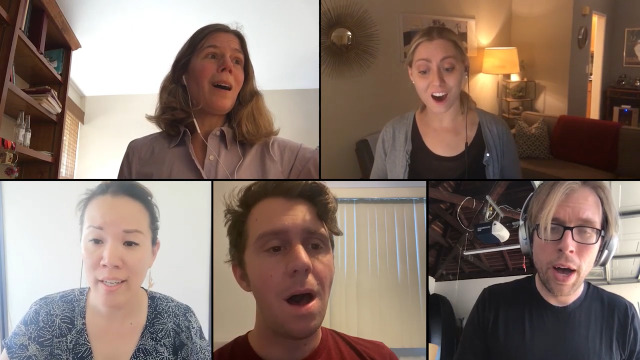
The church services have not been heavy on music, and I didn’t expect them to be, given the difficulty of creating so-called virtual choirs. I was glad, then, to see this on April 26 service and charmed by the performance:

The piece is William Byrd‘s “I Will Not Leave You Comfortless” (“Non vos relinquam orphanos“), performed here by the principal singers of the St. James Episcopal Church choir. It’s from the composer’s Gradualia, a set of 109 sacred motets published in two volumes in 1605 and 1607. The five-voice piece sets John 14:18 and 16:22:

I will not leave you comfortless, Alleluia
I go, and I will come to you, Alleluia.
and your heart shall be joyful, Alleluia.

Byrd (1543-1623) spent his entire career in the service of the British Royal Family, which is remarkable given that he was a staunch Catholic at a time during the reigns of Elizabeth I and James I when the practice of Catholicism was illegal. With the Gradualia, Byrd may have been expressing a commitment to his branch of Christianity, demonstrating a rebellious streak, or preparing for the return of Catholicism to England (because at that time, Anglicanism was not necessarily a done deal). Whatever the motivation, he wrote the Gradualia as unapologetically Catholic music. It was no one-off either, as he composed a number of pieces for the Catholic mass, including versions of the Ordinary set for three, four, and five voices. None of this music was probably heard during Byrd’s time by anyone but the composer and a small group of Catholic loyalists; people were arrested for simply owning the Gradualia.

In the Gradualia, Byrd ascribed each motet to a particular feast day in the Catholic liturgical year. He wrote “I Will Not Leave You Comfortless” for Pentecost, which just happens to be today. Happy Pentecost!

Digital Events Are Probably Not the Answer

Almost immediately after COVID-19 shut down concert halls, performers, producers, and presenting organizations started creating digital content to keep their audiences engaged. The question now is whether the web can deliver online performances as a replacement for live events if venues remain closed. A couple of early surveys addressed the issue, providing some clarity on the efficacy of digital concerts.

The short answer: streaming, live or pre-recorded, doesn’t appear to be replacing live concerts any time soon.

Seventy-three percent of the 2,000 polled by Enigma Research agreed that “Livestreaming or virtual experiences are no substitute for live events,” and a Live Nation survey yielded a similar result: 85% were viewing livestreams as a substitute during the COVID-19 shutdown, but did not see the experience as a replacement for live music. People are going to come back to live events, even if their return will be slow and tentative.

That doesn’t mean that people don’t like digital content. It’s fine as a diversion, as long as they don’t have to pay. While 75% of people in the Enigma survey found free digital content to be very or somewhat appealing, only 7% of people found a pay-per-view option to be very appealing, while 66% found it to be unappealing.

This reluctance to pay makes a certain amount of intuitive sense. Since the early days of the shutdown, performers, entertainers, and arts organizations big and small have been providing complimentary access to a lot of premium content in the name of keeping their “families” “engaged.” But once one starts giving stuff away for free, it’s really hard to go back and ask people to pay for it. As we go forward, any scent of monetary gain may be looked at skeptically–ask John Krasinski.

To have any hope at turning digital concerts into a money maker, a well-thought-out strategy to create something that is artistically distinct is essential. For non-profits, it may mean framing the payment not as a virtual ticket but as a donation, an investment by others in your return to on-stage greatness. Creating third-party validation, through a sponsor or guest artist, may help generate interest, as would a marketing strategy that fully exploits all available digital marketing tools to attract audiences beyond your market area.

UPDATE: Just for fun, I thought I’d share the Los Angeles Master Chorale’s virtual-choir performance of Hark, I Hear the Harps Eternal, which we deployed on social media last week. It’s done exceedingly well for us, and is a rousing, uplifting two minutes. Enjoy.

The Slow, Tentative Return of Audiences after COVID-19

Data is coming in, giving us a picture of what audiences will look like when cultural organizations open up after COVID-19: in short, they’ll be small and nervous. Shugoll Research released its study of Washington, DC, theatergoers back in April, and earlier this week they released their national version. With only 36% of respondents saying they are very likely to return to theaters, and with 63% expecting to wait three months to a year before they venture out, Shugoll predicts that we will see a slow “trickle back” to theaters. Less than half of frequent attendees say they will return in the coming season, and 57% of those will wait “a few months”; 45% of the over-55 crowd say they’ll wait six months to return. Only 21% of them identify themselves as likely to return at all.On the same day Shugoll Research released their national survey results, Colleen Dilenschneider posted the latest on her ongoing COVID-19 audience study. While interest in attending something within the next three months has been growing, most people are still more likely to stay home for at least a year. (UPDATE: In her May 18 post, Dilenschneider notes that the three-month intention to return are at the same value now as they were this time last year, and one-month intentions are “rapidly recovering.”) When Dilenschneider asked people what would make them feel safe and comfortable in a cultural venue, 85% said having a COVID-19 vaccine; 65% said the lifting of restrictions. Sixty-four percent of Shugoll survey participants saying they’d come back if there was a vaccine, and 50% want to see increased cleaning and disinfecting.It’s frustrating to know that a lot of the things needed to attract audiences are out of one’s control (cultural organizations can’t simply order up a vaccine or lift government stay-at-home orders). It’s also concerning that audiences don’t want to make a move until other attendees get out there to test the safety of the environment first (61% percent of Dilenschneider’s subjects said seeing others visit would encourage them to return). It’s clear that, based on what we know now, this will be a very gradual, hesitant, fear-ridden trickle back.

 Outside the High-Culture World Audiences Are More Brazen

The return may be a little less tentative, however, for venues and presenters outside the realm of high culture. When Enigma Research surveyed 2,000 Americans and Canadians who had attended a broader range of “live sports events, festivals, fairs, shows, or conferences within the last 24 months,” they found, on the other hand, that 76% are likely to return, and 48% are ready to attend a public event within one to two weeks of things opening up. Live Nation’s recent international survey of their customers showed that 91% are likely to attend a live music event post-COVID-19.While the majority of respondents to all four of these surveys want to see increased cleaning and disinfecting of venues, Live Nation and Enigma results show that their people are cold to additional measures that might affect the event experience. Only 21% of Live Nation respondents would attend an event if required to wear a mask, and 27% of Enigma respondents showed reluctance to wear a mask. In the Shugoll and Dilenschneider surveys, a vaccine is a prerequisite to returning for most (65% and 85%, respectively), but only 18% Enigma respondents need to have a vaccine to attend events again.The reason for the differences in attitudes could be attributed to age  (high-culture attendees tend to be above 55, a vulnerable group), politics, or may even speak to the differences in behavior expected at events (I may not care if I have a mask at a chamber music performance, but at a rock concert, I might not want to scream my appreciation through a screen of cotton). It will be interesting to see how attitudes of fans of different activities continue to diverge, or converge, over time.  

Now Here’s an Opera Steve Smith Thought You Might Enjoy

Today, the New York Times classical-music critics each picked two contemporary operas of note, one of which was to have found a “niche” in the repertoire. Here’s what Steve Smith picked:
Robert Ashley’s Perfect Lives is available on DVD, if you’re interested, or you can watch it on YouTube. Someone on YouTube commented that they remembered this airing on the USA Network in the early ’80s.

Better Know a Composer: Ernst Toch

If you know Ernst Toch for anything, it’s probably this:
“Geographical Fugue”is a perfect tongue twister of a showpiece for high-school and university choirs, the kind of rhythmic, referential, kind-of-humorous diversion that moms and younger brothers love (“Hey ma, it’s just a bunch of names of places! Lake Titicaca! Get it: titty-kaka? Ha!”).

It certainly didn’t start out that way.

The “Geographical Fugue” was the third movement of Gesprochene Musik (Spoken Music), which Toch premiered at the Berlin Festival of Contemporary Music in 1930. Toch had not written the piece to be performed live, but rather had it pre-recorded and played back at 45 rpm on a gramophone:
 
Gesprochene Musik was a wry bit of musical experimentation, an early example of electronic experimentation shot through with Weimar-era modernist wit.

Three years later, as the Nazis came to power, Toch’s burgeoning career in Germany ended when he fled continental Europe. After two years in London–productive ones, he scored three films–Toch made his way to the United States, first settling in New York, and then moving to Los Angeles. There, he earned a living writing film soundtracks, ultimately writing 16 and earning three Academy Award nominations.

It was also in Los Angeles, during a 14-year period from 1950 until his death in 1964, that Toch wrote all seven of his symphonies. Although the New Grove Dictionary of Music and Musicians dismissively describes them as “late Romantic,” Toch’s symphonies are skillful, entertaining, and moving, combining the best of Wagner, Strauss, and Schoenberg with sharp modernist shocks that provide moments of genuine drama:

Symphony No. 3, premiered by the Pittsburgh Symphony on December 2, 1955, won the Pulitzer Prize the following year, but the fifth is also highly recommended.

Our Society is Crumbling: Blame Vin Diesel and Andy Samberg

Matthew Yglesias, the day after Paul Walker died, explains the the popularity of the Fast and the Furious franchise in terms of increasing income inequality in America:

In a world where the system increasingly seems to be rigged, it’s natural to turn to the Dominic Torettos of the world as heroes. Yet Dom, for all his hard work, ingenuity, and undeniable skill doesn’t really do anything useful or productive. He’s a nice guy who’s loyal to his friends and family. He lives by a code. And his outlook is increasingly appealing in an increasingly unequal America. But it’s ultimately destructive of the social institutions needed to generate prosperity.

In the Fast and the Furious movies, characters make choices that value personal relationships over  legal institutions; these decisions make perfect sense, according to Yglesias, to an audience that sees the societal game rigged so that the rich (presumably, not them) get richer while the poor stay where they are (or worse).

I’ve been thinking about the eroding of a particular traditional institution, the family, since watching the Thanksgiving episode of Brooklyn Nine-Nine. On the show, NYPD detective Jake Peralta eschews Turkey Day because he never had a happy one: when he was a child, his father left him and his mother, and she always had to work on the holiday. The lesson learned at the end of the episode was that Jake’s real family was his work colleagues, and that, because of his love for them, he could now enjoy Thanksgiving as an adult.

So, just as the Fast and the Furious franchise thumbs its nose at law enforcement, so does Brooklyn Nine-Nine realign our notion of family. The interesting twist in the TV show is that Jake shows his love not only for the people, but also for the NYPD as a whole, reinforcing the role of one as it disses the other. A perfect message for the surveillance-state era?